

Every tool I’ve built started with a moment of friction I couldn’t shake.
With Prompt Intent, I was trying to draft a proposal with an AI assistant. I typed something like “help me write a proposal for my project” and got back a perfectly competent, perfectly useless five paragraphs. It wasn’t wrong. It just had no idea what I actually meant.
The problem wasn’t the model. It was me.
The blindspot
When you sit down to type a prompt, all the context — background, constraints, tone, audience — lives in your head. None of it makes it into the text box. The model fills in the blanks as best it can, which is usually not that well.
I kept noticing this. People complained that AI “just doesn’t get it,” but their prompts were genuinely ambiguous. There was no way to get it from those inputs. I wanted something that caught those gaps before you hit enter — not a template, but something that asked the right follow-up questions the way a good colleague might.
Why on-device
The privacy angle became obvious pretty quickly. The whole point is to intercept your prompt while you’re still writing it — before you’ve even decided it’s shareable. Sending that to a server felt wrong.
Chrome’s built-in Gemini Nano changed things. I could run inference locally, in the browser, no network calls. Nothing leaves your device. That constraint also forced me to keep the interaction tight, since on-device models have real latency. Every question the extension asks has to earn its keep.
One question at a time
The first version asked too many questions at once. Users (including me) just dismissed it. It felt like a form.
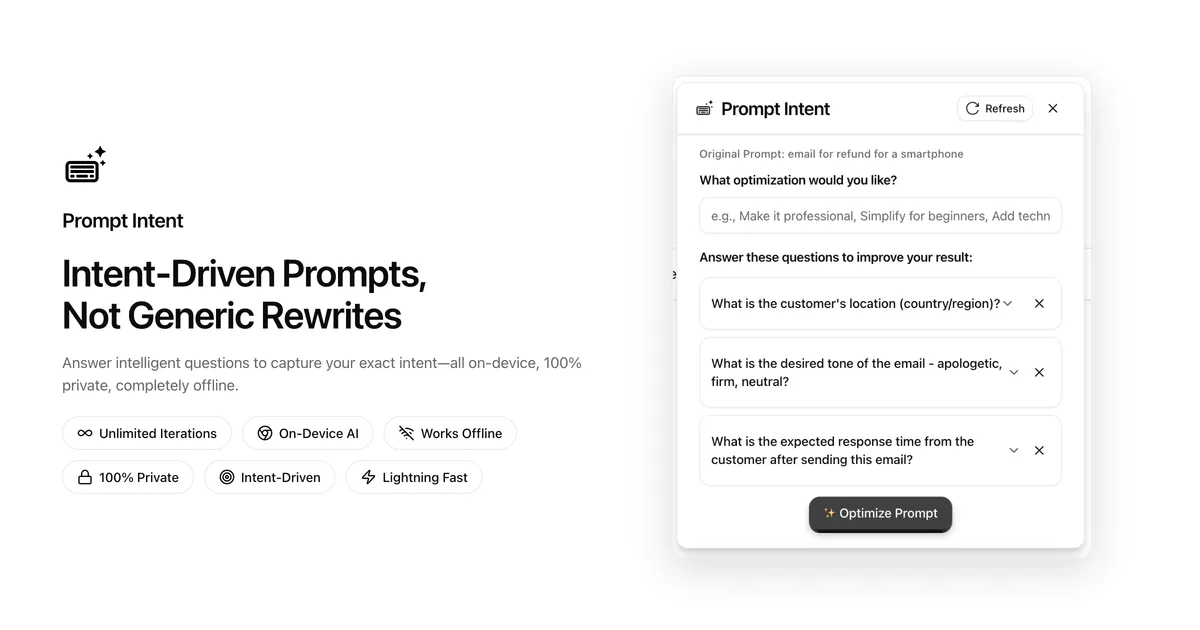
The thing that unlocked the design: ask one question, wait, then ask another if needed. Instead of interrogating you upfront, Prompt Intent identifies the single biggest ambiguity, waits for your answer, and either asks one more thing or confirms you’re ready. Two or three targeted questions get you 90% of the way there.
Shipping it
Most of the hard work was the Prompt API integration. The documentation had gaps, so a lot of it was trial and error. Getting the model to produce a single, well-formed question — not a paragraph — took some prompt engineering on my end.
The UI is deliberately minimal: a small popover that appears when you’re typing in any text area, on any page. No settings panel, no dashboard, no account.
I shipped it to a handful of people I trusted to be honest. Most of the feedback was about timing — when the popover appeared relative to the writing flow. That tuning took longer than building the core feature.
What I learned
The value isn’t really the AI. It’s the pause. Prompt Intent works because it inserts a small moment of reflection between the impulse to type and the act of submitting. The questions aren’t magic — they’re just reminders to think about what you actually want.
A lot of AI frustration is really frustration with yourself for not knowing how to ask. Building something that addresses that felt more useful than building something that generates shinier output from the same vague input.
The extension is at promptintent.talmiz.com.